Want your site to show up in AI answers?
2026-08-13
More and more people get their answers straight from AI — ChatGPT, Google's AI Overviews, Perplexity — without ever clicking a blue link. If your site isn't part of those answers, you're invisible to them. The good news: getting ready is mostly things you already do for good SEO.
First, the honest truth
There is no official "AI SEO" standard, and no secret tag that guarantees you show up. The field is new, the rules change almost monthly, and every AI company does it a little differently. Anyone selling you a guaranteed "GEO" or "AIO" formula is guessing.
But that's not a reason to do nothing. The habits that help AI understand and cite your page are stable, low-risk, and help normal search too. It's worth preparing now.
Draft ideas to prepare (not a rulebook)
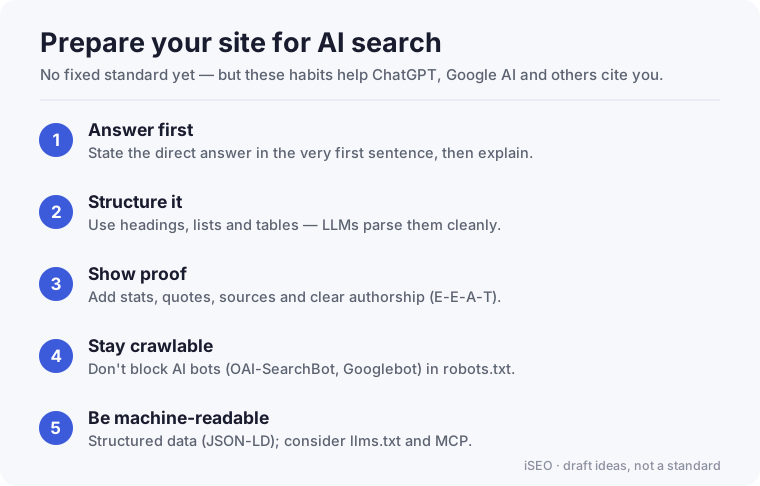
These are practical, widely-agreed starting points — treat them as a checklist to experiment with, not a standard:
- Answer first. AI models favour clear, definitive answers. Put the answer in the first sentence, then explain.
- Structure it. LLMs parse lists, tables and clear headings well. Break content into scannable sections.
- Show proof. Content with stats, quotes, sources and named authors gets cited more — it helps the AI trust and verify it.
- Stay crawlable. If you block AI search bots in robots.txt, you can't be cited. Check what you allow — iSEO's RobotsReader shows exactly that.
- Be machine-readable. Structured data (JSON-LD) and emerging files like llms.txt make your meaning explicit instead of guessed.
Can you get your link into Google's AI Overview?
Short answer: you can't submit or force it. There's no dashboard or setting in Google Search Console that adds your link to an AI Overview — it's generated by AI from sources it already trusts. What you can do is make your site the clearest, most authoritative source on your topic, so the AI picks you:
- Build brand authority. AI leans on sites that others talk about. When reputable blogs, news and industry sites mention and link to you as a go-to source, Google's AI is far more likely to cite you. Google: helpful, people-first content
- Answer the query directly on your page. State plainly what you are, using the words people actually search — on your homepage or About page. Spoon-feed the AI a clear, concise definition and it's easier for it to cite you. Google: AI features & your site
- Add schema markup. Mark your site up as a
WebSiteorOrganizationand define your brand name and purpose, so Google understands your brand as an entity and can connect the name to your URL. Google: structured data - Get traditional SEO right. AI Overviews lean heavily on pages that already rank. Fast, mobile-friendly, genuinely helpful pages are the ones the AI tends to choose. The SEO basics checklist
Notice these are the same habits as above — being the trustworthy, clearly-defined, well-ranked source is the whole game.
Where the official docs actually are
No single standard — but the big players each document how their systems read and cite you. Go here to go deep:
| Company / standard | What it covers | Official doc |
|---|---|---|
| Google (AI Overviews) | How to be eligible for AI features — no special markup needed | Google: AI features & your site |
| OpenAI (ChatGPT search) | Its crawlers — allow OAI-SearchBot for citations vs GPTBot for training | OpenAI: bots & crawlers |
| Anthropic — MCP | Feed structured data straight to AI agents | Model Context Protocol |
| Chrome — llms.txt | A proposed file telling AI agents what your site is about | Chrome: llms.txt |
| Chrome — WebMCP | Declarative annotations so agents can use your page | Chrome: WebMCP |
**MCP and WebMCP make your site usable by an AI agent — not discoverable in AI answers.** They only matter once a user connects your service to their assistant, and they don't affect whether you get cited. Add them if you're building agent features, not for search visibility.
The takeaway
You can't "game" AI search, and you don't need to. Write genuinely helpful, well-structured, well-sourced content; keep it crawlable and machine-readable; and revisit as the tools evolve. Do that and you're prepared for whatever AI search becomes next.